For Native Hawai‘ian advocate Edward Halealoha Ayau, caring for the dead has been a lifelong duty. It has also been a matter of steadily increasing legal traction.
While earning his law degree at the University of Colorado in the late 1980s, Ayau mastered case law, argumentation, and objectivity, both in the classroom and while clerking for the Native American Rights Fund (NARF). Nevertheless, such rigorous studies could hardly have prepared Ayau for what he would encounter when, while still a law student, he was called back to Hawaiʻi to witness the unearthing of a mass grave.
By that time it was common knowledge that colonial-era violence of the 1890s through the early twentieth century had resulted in the creation of countless Indigenous mass graves across Ayau’s homeland. That societal wound, thought by many to be long buried in the past, continues to resurface on the mainland United States as well as throughout the Hawai‘ian archipelago. Now as he gazed across the overturned dunes of a luxury hotel going up at Maui, it was clear that backhoes had just unearthed hundreds of iwi kūpuna—bones of ancestors. The event certainly was newsworthy and soon sparked local resistance, ultimately resulting in the hotel’s having to move farther inland. But for the young law student, the experience would prove transformative. “It was the most painful thing I ever experienced,” Ayau says, looking back on the moment. From that day forward, he intimately understood that the work of cross-cultural repair would require much more than legal training.
Ayau recalled how that experience led to a decisive and enduring outcome:
During that time, I quickly realized that while the legal side [of my training] was important … cultural training is required in understanding these issues. There [usually] is a line between your advocacy and your independence of thought, but in this case, it’s impossible to maintain that situation.
The tension Ayau recognized to himself that momentous day arguably sits at the heart of all repatriation work: The law can compel institutions to act, but it cannot compel them to care. Indigenous remains frequently end up in powerful museums and universities, where they are cataloged as objects of scientific study rather than received as people deserving of return to their origins.
Commenting on the Foundation’s support of this repatriation work, Jonathan Van Antwerpen who leads the Foundation’s Religion & Theology Program points to Ayau’s exemplary efforts of some three decades:
What draws the Luce Foundation to this work is what drew Ayau to it: the understanding that returning ancestral remains is an act of sacred repair, not just compliance to legal precedent. We also believe that when institutions learn to treat Indigenous communities as partners rather than as subjects, something larger shifts to the benefit of all communities.
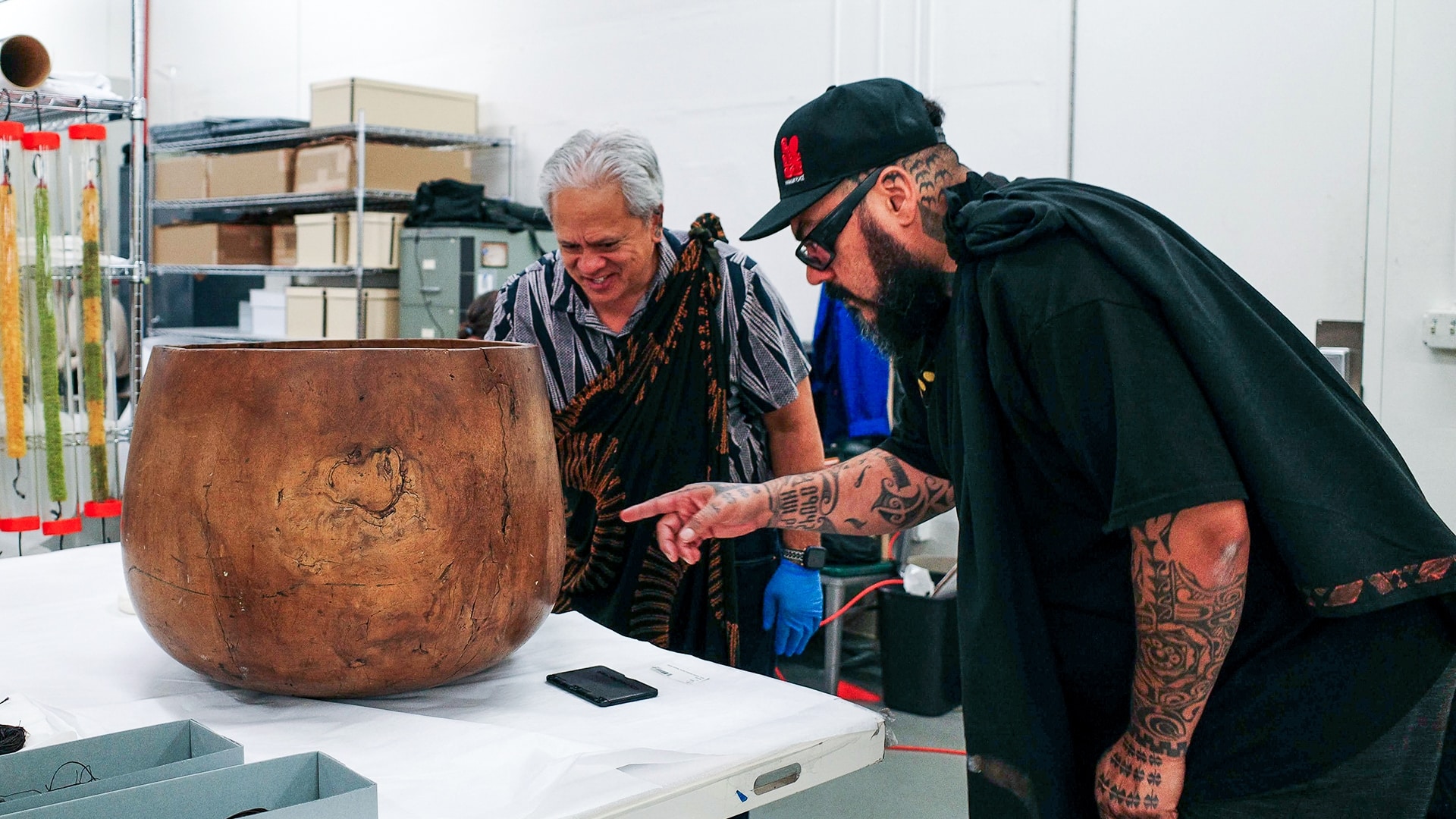
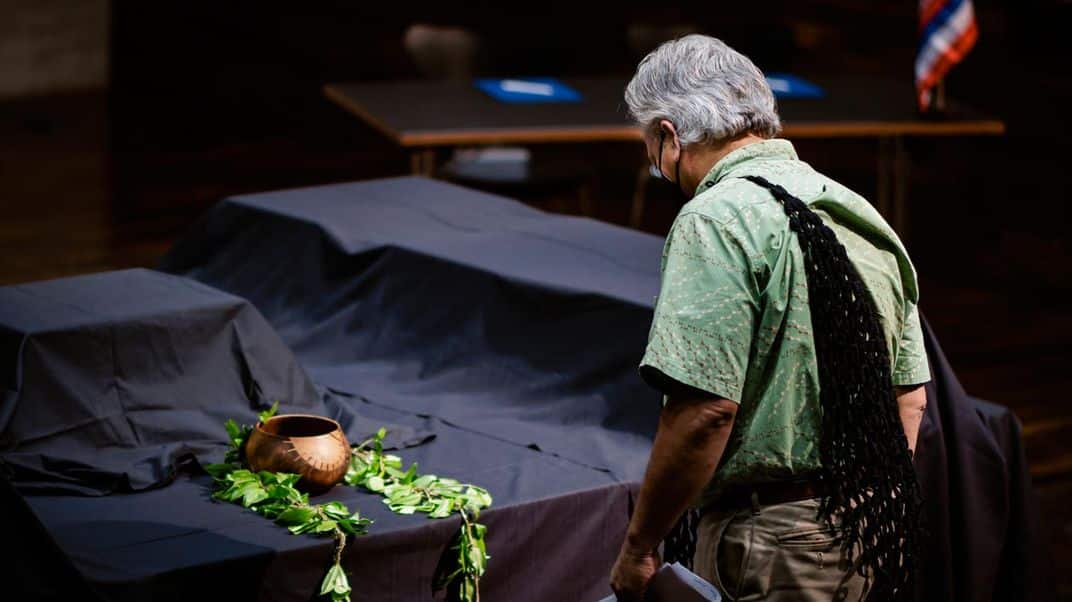
Halealoha Ayau, left, admired the craftsmanship of an ‘umeke nui (large calabash) before it was transported to Hawaii. The object was among more than 300 that UC Berkeley recently repatriated to Native Hawaiians. Photo by Dane Uluwehi Maxwell
In the late 1980s, as the Native American Graves Protection and Repatriation Act (NAGPRA) was being shaped by the U.S. Government—it would be signed into law in November 1990—Ayau had already helped build the legal mechanisms that would give Indigenous communities enforceable rights to reclaim ancestral remains and sacred items from federally-funded institutions. NAGPRA (on whose advisory Review Committee Ayau continues to sit until late 2026) established compulsive inventory requirements, consultation standards, and repatriation procedures, together providing a framework for accountability where none had previously existed.
But as Ayau himself points out, accountability and care are not one and the same thing:
Law does not take into account cultural and spiritual sensitivities. It’s premised on objectivity…but sometimes that objectivity compromises the spiritual integrity of the ancestors you’re dealing with.
Civic repair, in Ayau’s practice, requires both. For over thirty years, he has helped facilitate the return of thousands of Native Hawai‘ian remains to the grounds of their origin from institutions across the United States and abroad. Yet NAGPRA’s reach has its limits, as many Indigenous communities outside the United States lack comparable legal protections, effectively leaving them without legal muscle to compel the repatriation of Indigenous remains held by foreign institutions.
Edward Halealoha Ayau leading the Hawaiian delegation in retrieving 58 sets of ancestral remains from five European museums. Photo by SPK / photothek.net / Felix Zahn
“We are now working on how to do what Ayau started thirty years ago,” says Dr. Greg Johnson, who directs the Walter H. Capps Center at the University of California, Santa Barbara, and who is currently leading a related Luce Foundation-supported project, Repatriation Futures, alongside Ayau and additional experts. Johnson also organizes field visits for Indigenous communities around the world who are navigating similar struggles. “[Ayau has] really been on the cutting edge of repatriation work because of his unique outlook.”
Together, Johnson and Ayau have been building replicable frameworks for the return of Indigenous remains that other communities can adapt to their unique circumstances, indeed as they begin their own processes of repair and healing. The need is acute: According to a 2023 ProPublica racial justice investigation, The Repatriation Project: The Delayed Return of Native Remains, more than 210,000 remains of Native Americans are still held by U.S. universities and museums (the website features a searchable database of problematic collections here). Hence, too many looted objects effectively remain disconnected from their tribal homes more than thirty years after NAGPRA was passed.
So, Ayau keeps returning to the negotiating table. Sitting across from curators and administrators who may not exactly share his perspective, he knows that his most effective instrument of persuasion cannot be legal pressure alone, but also something we cannot legislate: a universal, moral obligation to treat all dead as kin. As Ayau comments:
We tell them, ‘Theft is theft is theft,’ and nothing good comes from it. You may think of [these objects] as disconnected human remains. But when we view them, we see them as our ancestors. We are not asserting [only] a legal right—we are reasserting a cultural responsibility.
Care, in other words, is not a supplement to the work of repatriation. Care is the work itself.