Each morning, before she walks into her office on Holman Street in Houston’s Third Ward, Danielle Burns Wilson is welcomed by the neighborhood.
The maintenance crew rolls past in a van, calling out hello. A longtime resident pauses mid-walk to share a scripture or an update about her grandson. Another neighbor appears in his signature brown coat. It’s a steady and familiar rhythm. “I’m always greeted with joy,” says Wilson, executive director of Project Row Houses.
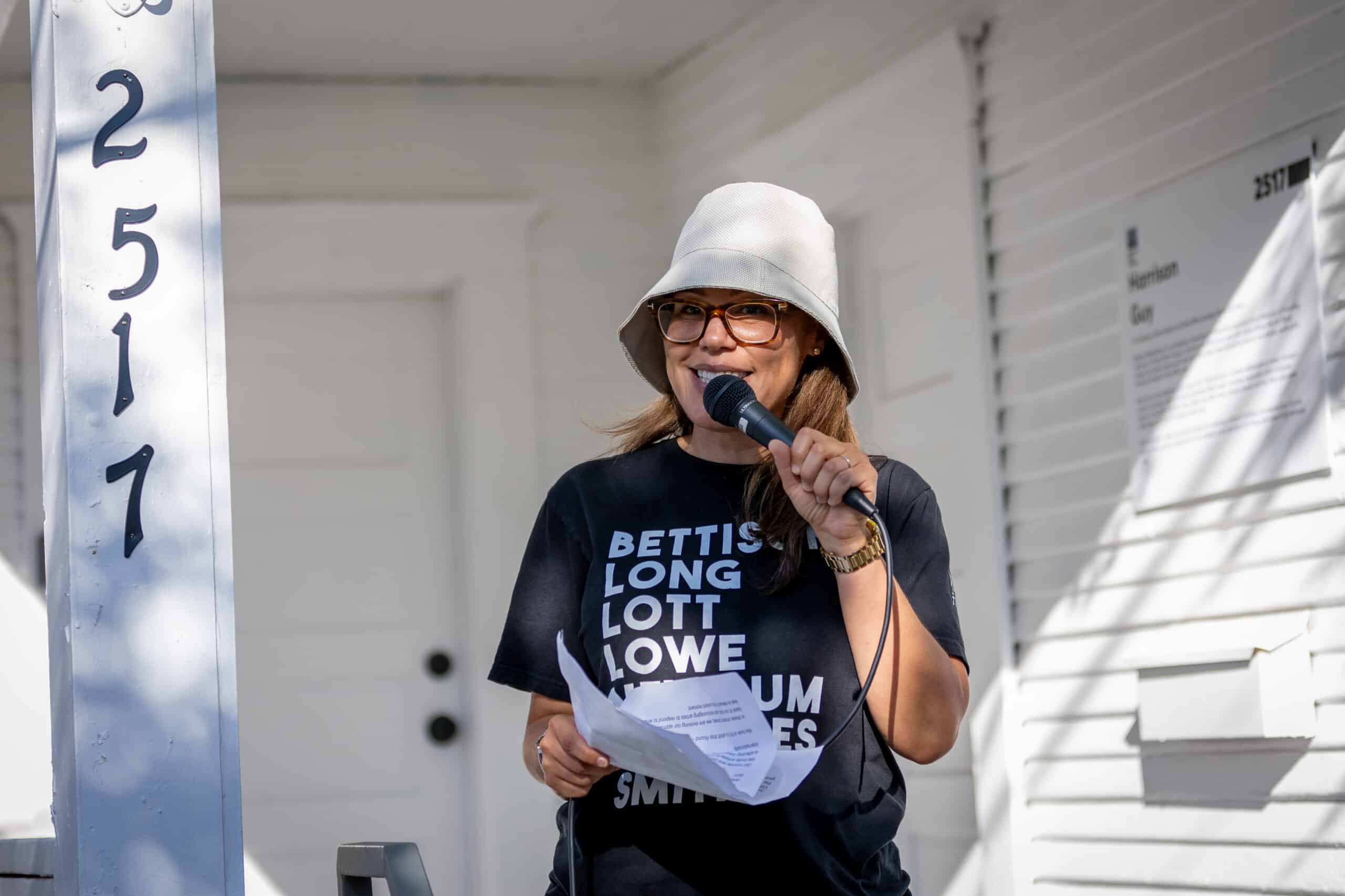
Project Row Houses Executive Director Danielle Burns Wilson speaking from a row house porch at the opening of “Artist Round 59.” Photo courtesy of Project Row Houses
The nonprofit is known for its rows of restored, white shotgun houses, standing where dilapidated structures once faced demolition. Founded in 1993 by seven visionary African American artists—James Bettison, Bert Long Jr., Jesse Lott, Rick Lowe, Floyd Newsum, Bert Samples, and George Smith—as an experiment in socially engaged art, Project Row Houses now spans five city blocks and 39 structures in one of Houston’s oldest Black neighborhoods. It is home to public art workshops, community markets, and career development programs for creatives. It is also something harder to categorize.
Wilson describes it as a “socially engaged call-and-response community.” Project Row Houses listens to what the neighborhood needs—and delivers. That responsiveness has shaped its evolution, from commissioning murals from local artists in the early 1990s to launching a residential program for young mothers, to reopening the historic Eldorado Ballroom in 2023. The organization’s mission shifts along with the collective it serves. “It’s very much a living thing,” Wilson says.
Her own connection to the Third Ward runs deep. Though she grew up on Houston’s southwest side, Wilson spent weekends with her grandmother in the neighborhood, where her father was raised. Years later, while working as a curator at Texas Southern University, she attended a gallery opening at Project Row Houses and was struck by its energy and the passionate artists within its orbit. Now, after nearly five years on staff, Wilson carries the honor—and shoulders the weight—of tending to a legacy created collectively: not by one founder or institution, but by a community. That duty now extends to the organization’s archives.
“Danielle is a force,” American Art Program Associate Jackie Edwards says after spending time at Project Row Houses. “She leads with a presence and dedication that drives that vision forward every day.”
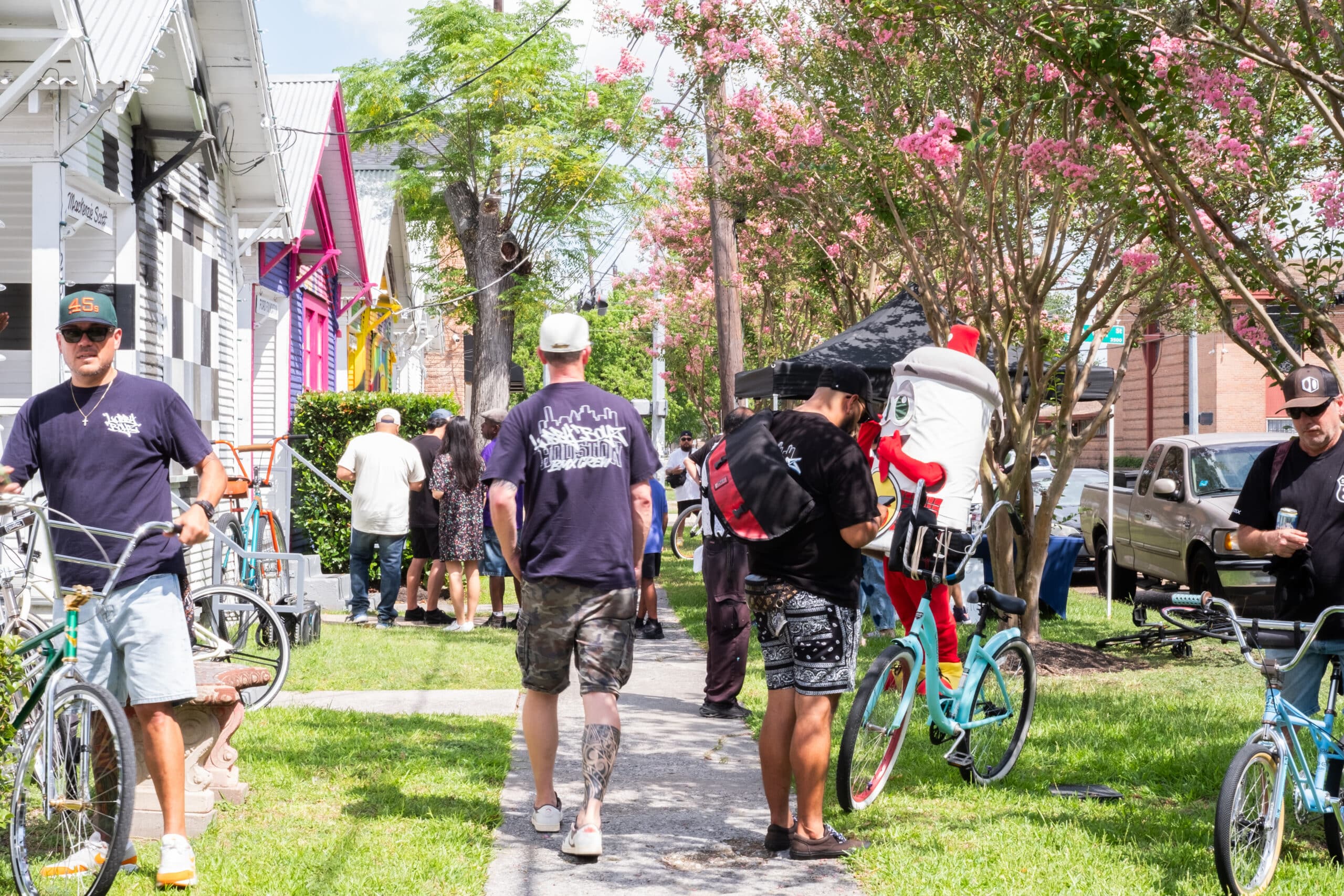
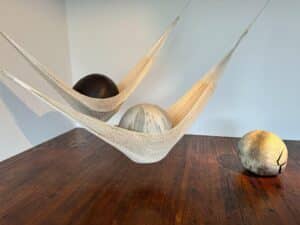
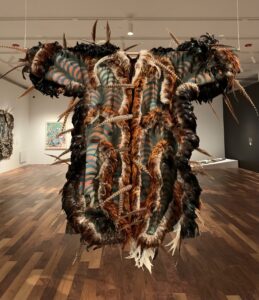
Round artists are asked to create programming around their installation. During “Artist Round 58: Free Someone,” artists Article and Craig “BBC” Long hosted a kickback on the row. Among those who pulled up were a local bike club and Mr. Rusto. Photo by Alex Barber
For more than 30 years, Project Row Houses has documented its politically themed, biannual art exhibitions, known as “Rounds,” along with its events and initiatives. Scholars, artists, and students regularly request materials, but much of that history lived in storage, packed by a team that lacked the time and archival expertise to create an organized system. Inside a single box, an extension cord might sit beside old documents, photographs, and vintage photo slides. The problem was never a lack of history—it was the difficulty of accessing it.
“We could get an inquiry about an artist who showed in Round Three,” Wilson says. “The requester remembers that someone took pictures. But where are those photos? We couldn’t have found them. Things were just tucked away in tons of different boxes.”
Through support from the Henry Luce Foundation, Project Row Houses launched a new initiative to process and digitize its archives as part of the PRH Institute, in partnership with the Houston Public Library’s African American History Research Center. With a target completion date of summer 2027, the project has a dedicated archival staff working with specialized equipment to create a publicly accessible record of the organization’s work. The effort isn’t merely administrative—it’s transformative.
Former board member Andrew Speckhard, who began volunteering with the young mothers program in the early 1990s and served for more than 25 years, believes the archive will reveal the depth of that sustained commitment. “Once it’s digitized and accessible, it will show what can be achieved when a community really cares, and they’re all in,” he says. “You can have generational change.”
Andrea Greer, senior advisor for strategy and research and a 12-year staff member, sees the archive as a reclamation of narrative authority. “Project Row Houses belongs to everyone,” she says. “But a lot of other people have had the chance to tell our story in a way that we never have. Hopefully, the archive will generate opportunities for us to share the full context, here in Houston, where people can access it.”
The partnership with the African American History Research Center—also known as the Gregory School—carries meaning beyond logistics. Built in 1926 as the first public school for African American children in Houston, the center has historically held fewer archival collections, in part because families are often cautious about parting with personal artifacts. By partnering with Project Row Houses, the Gregory School stands to gain a significant body of material showcasing the Third Ward’s cultural life. Together, the two archives offer a fuller account of the neighborhood’s past and present. “You can research Project Row Houses,” Wilson says, “and then go to the Gregory School and understand the broader history of the neighborhood that made us possible.”
Randall Griffey, who directs Henry Luce Foundation’s American Art Program, sees Project Row Houses as a model for what civic repair can look like when it is rooted in place.
“Project Row Houses demonstrates that art is not incidental to community healing—it is the mechanism. By preserving its own archive, the organization is insisting that this neighborhood’s story be told on its own terms, and that is as important as any gallery exhibition or public installation.”
For Griffey, the work happening in the Third Ward points toward a broader reckoning with how American communities document, reclaim, and transmit the histories that sustain them.
Care is often associated with personal relationships. At Project Row Houses, it also takes the form of stewardship—organizing and digitizing decades of history for the people who created it. It is a way of repairing gaps in the record and reinforcing a sense of belonging in a neighborhood that has faced sustained change. In that sense, preservation becomes a civic practice that helps a community hold its ground. Edwards explains:
“Seeing Project Row Houses in action made its dynamic, ongoing exchange with the community unmistakably clear; an exchange that this archive project will make accessible to so many
For Wilson, the archive is not an endpoint; it’s an invitation. “I hope people feel inspired,” she says. “I hope they feel a call to action. I hope they feel connected, and I hope they want to be a catalyst for change.”
On Holman Street, the greetings continue each morning. The houses sit. The work expands. Legacies are not only what we inherit—they are what we choose to tend.