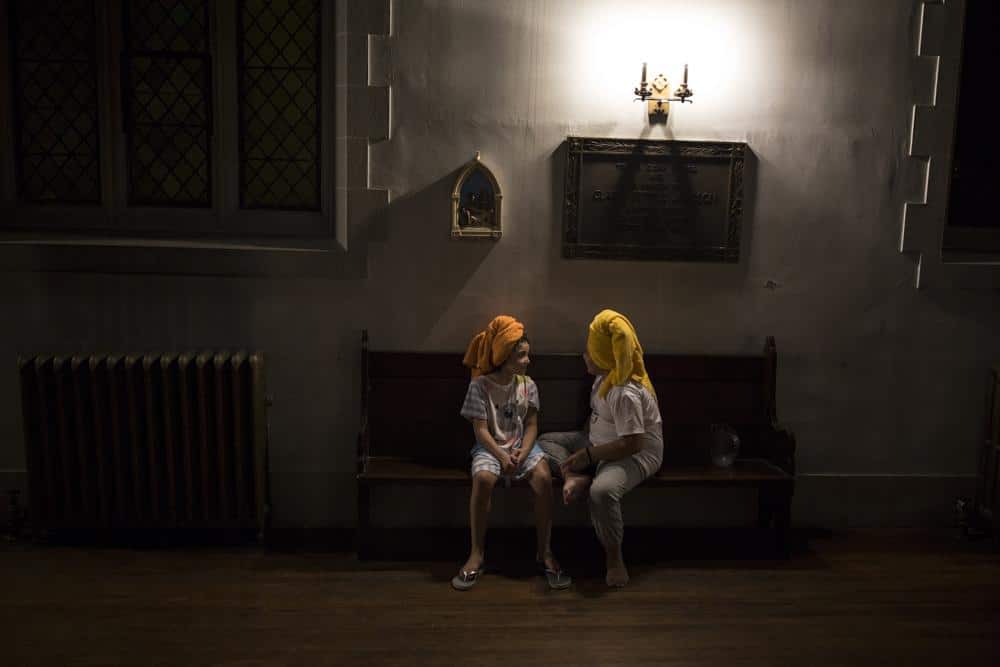
The Pew, New York City, 2017. Photo by Cinthya Santos-Briones
Two girls sit facing one another, legs touching, hair wrapped in colorful towels. They appear immersed in gossip that only sisters would indulge. It is a common image of girlhood, but for the context. Their small figures are seated on a pew, beneath a wall sconce, the image’s only source of light in an otherwise dark, cavernous room.
The photograph, titled The Pew, is part of artist Cinthya Santos-Briones’s ongoing series Living in Sanctuary, which captures the lives of various undocumented migrants taking refuge against deportation in churches across the United States.
In the series, which is currently on view at Baxter St at the Camera Club of New York through August 12, Santos-Briones explores the duality of sheltering in “sanctuary.” While her subjects, or “collaborators,” as she prefers to imagine them, experience physical safety, they also live under “a kind of church arrest,” says Santos-Briones, since venturing outside in any capacity would risk deportation.
Santos-Briones began the series in 2017 after the two girls’ mother, Amanda, sought help from her husband, Lutheran Reverend Juan Carlos Ruiz, a co-founder of the New Sanctuary Movement. Amanda was facing deportation to Guatemala, a country experiencing crushing poverty and endemic violence, as well as separation from her daughters, Dulce and Diniela, and her son Daniel, all three of whom were born in the US. Ruiz connected Amanda’s family with another church in Washington Heights that was able to house them.
During this time, Santos-Briones observed how media outlets often depicted undocumented migrants as either victims or heroes. What she was interested in capturing, instead, was migrants’ everyday realities living in sanctuary, which included everything from celebrating the biggest days of the year—Christmas, Thanksgiving, and birthdays—to the daily monotony of cleaning, cooking, and watching TV. In “Playground,” which again features the sisters, this time joined by their brother, church banisters are transformed into balancing beams. All at once, the image captures the girls creating beauty and joy, just as they had in “The Pew,” and surrounded by darkness and hidden away indoors.
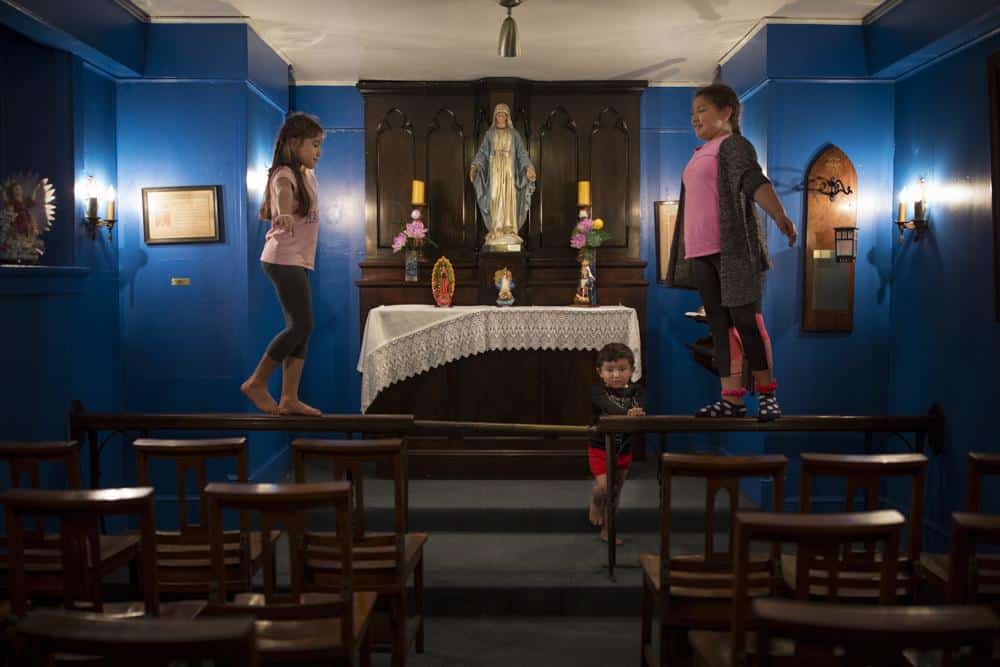
The Playground, New York City, 2017. Photo by Cinthya Santos-Briones
“These churches are spaces of calm and quiet, but also institutional spaces that are not normally inhabited,” says Kristen Lubben, executive director of Magnum Foundation, the nonprofit organization that has worked with Santos-Briones across various projects over the last ten years. “They are spaces of sanctuary, but there’s a certain—not claustrophobia—but containment in them as well.”
Santos-Briones was awarded a 2017 Magnum Foundation fellowship supporting work at the intersection of religion and migration, a program made possible in part through Henry Luce Foundation’s support. As part of the fellowship selection process, Luce invited religion specialists to work alongside photography experts. “It pushed us to think about who the work is for and who decides what stories get told,” says Lubben. “It’s great if the work winds up in a museum or a publication, but what’s even more interesting is thinking about how it’s brought back to the communities and subjects it emerges out of, how they’re activating it, how they’re using it, whether they feel seen or that it serves their purpose in some way.”
“Sanctuary is one of the oldest practices in religious life, and here it was unfolding in real time, in ordinary churches, among people most of us will never meet,” says Jonathan VanAntwerpen, who leads Luce’s Religion and Theology Program. “What Cinthya’s photographs do is make that visible without flattening it into a single story. That’s exactly the kind of public storytelling we hope to support—work that deepens understanding of the complex, everyday workings of religion through stories that reach and engage communities, including faith communities themselves.”
For the series, Santos-Briones often stayed months at a time—up to a year in the case of Amanda’s family—living near or alongside her collaborators in sanctuary. During her trip to Albuquerque, New Mexico, which was funded by the fellowship, Santos-Briones met a man named Kadhim who had worked in the US Army as a linguist during the first Iraq War. For three months, she stayed close to the church basement where he and his wife were living. Often, the camera was put away entirely, and they spent their days together eating, chatting, and, on occasion, even secretly smoking cigarettes. “He was speaking to me about the Mexican telenovelas because he watched *María Mercedes* and the telenovelas from Iraq.” Eventually, he started affectionately calling Santos-Briones “Maria” after the show: “Maria, Maria, how are you, Maria?”
From the perspective of the state, jailing undocumented migrants would be too costly, explained Santos-Briones. As a result, Kadhim wore an ankle monitor as part of an “alternative arrest”—a version of what US Immigration and Customs Enforcement now formally calls its Alternatives to Detention program. “What this country has done is create the idea linking Muslims to terrorists,” says Santos-Briones, noting the discriminatory practices even within the country’s treatment of undocumented migrants.
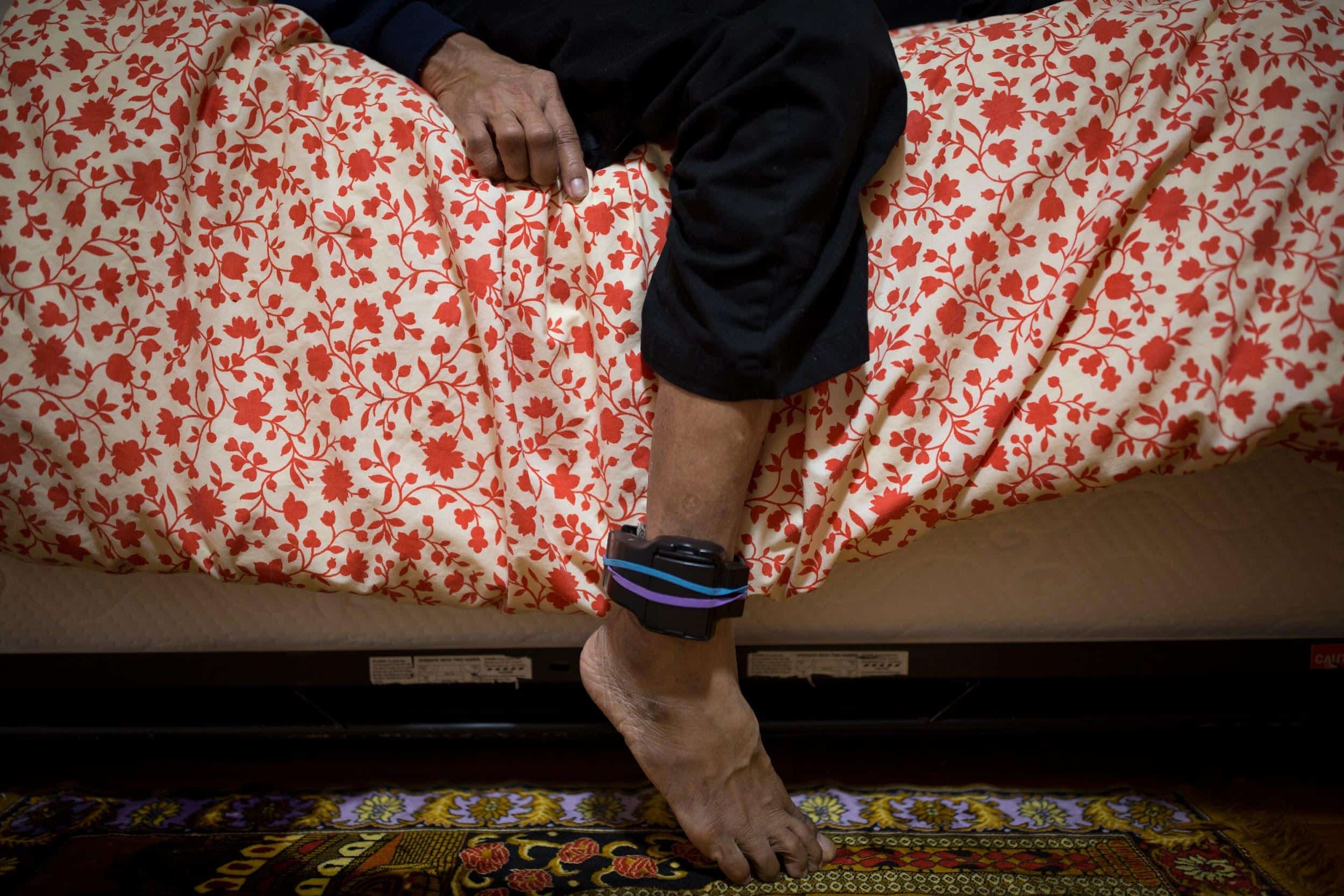
The Ankle Monitor, Meriden, Connecticut, 2018. Photo by Cinthya Santos-Briones
“Kadhim was taking a lot of medicine. Sometimes he was crying,” says Santos-Briones. “Imagine this strong-looking man in pain? He had diabetes. He had hypertension, heart disease. Being in sanctuary accelerates all of this illness. One of his sons was killed by police in Oklahoma. He couldn’t go to the funeral. It was really terrible.” Kadhim died two years after he left sanctuary.
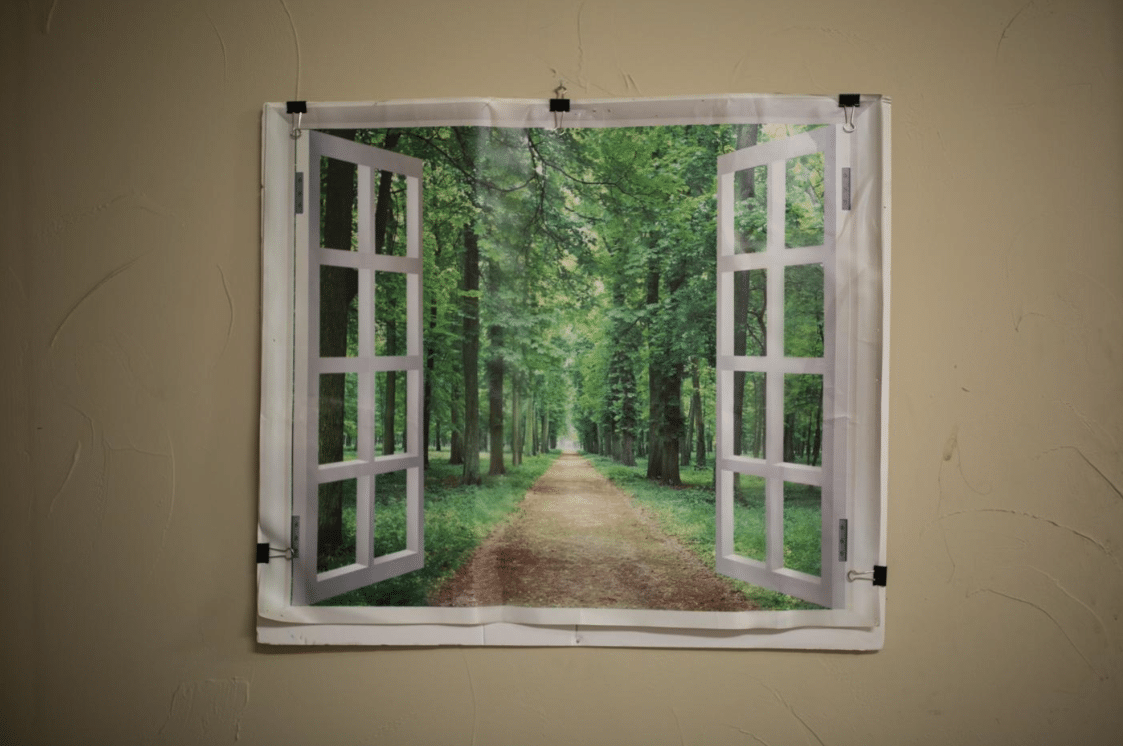
Dispositivo de contemplación Paisaje portátil Umbral artificial, New Mexico, 2018. Photo by Cinthya Santos-Briones
For Lubben, one of the images from the series that resonates with her most deeply is “Dispositivo de contemplación Paisaje portátil Umbral artificial.” The photograph captures the image of a window opening up to a forested path. “It tears at you because it’s this man’s attempt to create a vision of the outside,” says Lubben. “It’s hard not to imagine what it would be like to have your safety dependent upon being essentially trapped in this way.” Lubben pauses before adding, “We can’t keep going on like this. This is a stopgap measure. Ultimately, we have to figure a way out that this isn’t necessary.” The work’s title translates to: “Contemplation device Portable landscape Artificial threshold.” Notably, there is no contextualization of this image or any in the exhibition. Even the image’s title had to be sought out in separate gallery materials. Santos-Briones’s images resist easy narrativization of the migrant experience and demand viewers viscerally experience human connection. In this way, Living in Sanctuary as a collection functions not only as a “contemplation device” but a real threshold for empathy.
Santos-Briones’s work consistently extends beyond photography into social practice. On five separate nights during her run at Baxter St, groups of two dozen or so women gathered in the gallery’s basement and formed sewing circles. They sat quietly in meditation and communion, weaving bright-colored threads through white linen, retracing phrases from the news related to the current anti-immigrant climate. They “transformed words designed for immediate media consumption into a space for dialogue, critical reflection, and collective witness,” described Santos-Briones. With their heads bowed over their hands and the gallery spotlights casting a ring around their hair, the women seemed consumed in a holy act. They looked like they were praying.