An anonymous voice emerges from crackling static: “Have you had the experience of not even being able to remember the names of people who were once dear to you?” That plaintive question is now the backbone of When We All Get to Heaven, a podcast born from the rescue of 1,200 cassette tapes, now constituting an invaluable audio record—or living archive—of American queer faith and endurance at the close of the twentieth century.
Long before it became regionally legendary, the Metropolitan Community Church of San Francisco (MCCSF, est. 1970) was a congregation singing their way through times of fear—and recording their prayers so that others might be comforted by them.
The rhapsodic voices have found a second life in When We All Get to Heaven, a testament to the community’s storied resilience and creative imagination—traits still in evidence today. As team lead of an archival project that recently brought the Henry Luce Foundation-supported podcast to fruition, religious studies scholar Lynne Gerber recently referred to the MCCSF, a platform of worship for the LGBTQ+ faithful, affectionately as “a combination of utter queerness and utter Christianness.”
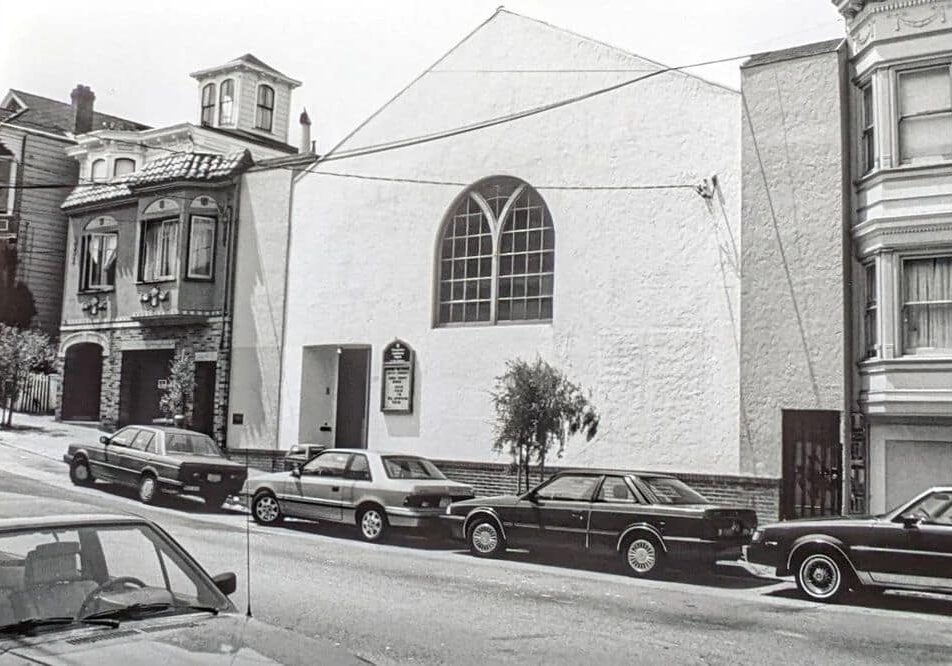
MCC-SF’s church building at 150 Eureka Street. Date unknown. Courtesy of MCC San Francisco Collection, San Francisco Public Library.
Gerber hadn’t gone in search of such an adventure; rather, “I stumbled onto this archive,” she recalls, when asked how she happened to take on the project. Apparently at some point in the church’s history—2025 marked its fiftieth anniversary—somebody salvaged a trove of the congregation’s prayer tapes from a dumpster, and then stuffed it for safekeeping under the floorboards of a sound room. There the 1,200 cassettes lay undisturbed for perhaps decades, gathering dust from overhead footsteps, and nearly falling into irreversible decay by the new millennium.
As Gerber recently mused, she initially “didn’t expect much” from the rediscovery, but what followed was nothing less than a revelation: More than one thousand hours of sermons, songs, and stories had been recorded on these cassettes—now seemingly awaiting a new following.
The first episode of the podcast retraces the story of the MCCSF during the rise of the AIDS (acquired immunodeficiency syndrome) pandemic in the early 1970s. Within two decades more than 10,000 people in San Francisco would die from HIV (human immunodeficiency virus) or AIDS (the most advanced stage of the virus). Indeed by 1992 fatalities from AIDS in the US alone surpassed 33,000 people. The MCCSF would see its own congregation diminished by 500 worshippers.
When We All Get to Heaven brings back that harrowing moment in history through gripping audio of the MCCSF’s Rev. Jim Mitulski—he was elected senior pastor in 1985—as he ministers to the community faithful. In the background the sick can be heard coughing; as the choir swells, the congregation spontaneously responds to the dramatic crescendo.
On even a brief listening it becomes clear that such tapes constitute a queer gospel of persistence recovered from the margins of collective memory. The voices on these tapes remind us to honor our ancestors—some still with us—and to always resist their erasure. Each sermon, cough, hymn, and ad hominem on these tapes becomes both testimony and elegy, every recording an act of remembrance that joins a broader effort to preserve the spiritual and cultural histories that shape American life.
“Utter Queerness and Utter Christianness”
Despite their originally dramatic context, rather than comprising a chronicle of despair, these recordings capture the enduring capacity of human resilience. As MCCSF became a haven for San Francisco’s queer community at the height of the epidemic (approx. 1987 to 1995), the church came to embody both material and spiritual refuge, blurring all boundaries between religion, activism, and mutual caregiving.
The tapes originated from the most practical circumstances: they were intended to serve congregants too ill to attend services in person. Given this background, Reverend Mitulski’s voice anchors much of this archive. Yet as Gerber reminds us, the ultimate power of this cache lies in the collective—that living, breathing thing we call community. “It’s not about him, separate from the world that sustains him,” she states. “It’s only ever an individual in relationship to the whole—the swell behind them. This project is about a community imagining possibilities together and holding to each other in a storm.”


Memory as Monument
For many today the storied AIDS crisis has receded into abstraction—grief and courage flattened by time. But these recordings collapse that distance. With the tapes now preserved digitally, a historic crisis can be aurally witnessed not only in loss, or mourning, but in MCCSF’s communal laughter, ritual, and song. When We All Get to Heaven ultimately insists that memory and collective imagination thrive not only in monuments or museums, but in the act of remembering itself.
“It’s about the practice of holding onto possibility in a nightmare,” Gerber says. “You have to practice it—and it’s a community practice.” As the choir conductor in one of the lively recordings exclaims after a triumphant rendition of When We All Get to Heaven, “If you can’t feel that, you’re dead!” Today the hymn, as well as many others, still reaches forward in a lively podcast—a pulse of faith echoing through generations.
Listen Now
Grant Details