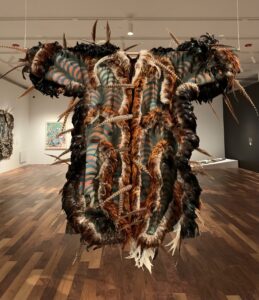
This summer, we visited the Smithsonian American Art Museum to see The Shape of Power, a Luce-supported exhibition that “examines the role of sculpture in understanding and constructing the concept of race in the United States.” We were deeply moved by both the artwork and the quiet tension surrounding it. Just months before, the exhibition had been mentioned in an executive order from the Trump administration, which accused the Smithsonian of “denigrating America’s heritage.”
We find ourselves in a moment where the right to narrate history—who gets to speak, which stories endure, and whose perspectives are erased—is up for grabs. What’s at stake is not just representation, but legacy. Who will define American history in this century? Who is shaping the archive of the future?
At the Henry Luce Foundation, we believe that democracy and justice are fostered daily through dialogue across divides, public discourse, the amplification of diverse voices, and investment in leadership. Part of this work involves telling, retelling, and reimagining our shared stories. Together, these narratives ensure that what we pass down is not a narrow inheritance, but an expansive legacy—one that accommodates complexity, contradiction, and the full humanity of all communities.
Despite the noise outside, The Shape of Power, which closes soon on September 14, achieved what great art always does: it invited reflection. Like us, thousands of visitors throughout the nearly year-long exhibition paused, took their time, and studied the works closely, leaving behind thoughtful notes about their experiences.
We also encountered the importance of multiple narratives in Santa Fe, New Mexico, at the Georgia O’Keeffe Museum. There, Bess Murphy, the Luce Curator of Art and Social Practice, collaborates with Native artists and community members to expand the museum’s story beyond O’Keeffe herself. In partnership with neighboring Tewa communities, they are constructing a living history of the land and its people, honoring Indigenous traditions and relationships that existed long before O’Keeffe made their mountains famous in distant places.
We see similar efforts in the Magnum Foundation’s Counter Histories Program, which supports photographers and storytellers working to reclaim erased and obscured memories and challenge established narratives. These artists are not merely documenting hidden truths; they are reframing what is deemed knowable and worthy of preservation, reminding us that photography can be a tool for justice.
At their core, all these initiatives recognize that story is power and that power solidifies into legacy—what is taught, archived, and inherited.
In the upcoming year, we will utilize the “Story as Legacy” series to highlight grantees engaged in creating worlds that embrace layered perspectives. In each quarterly edition, we will explore how artists, journalists, curators, and leaders are shaping the stories that shape us. We will ask: How does storytelling build justice? How do stories passed down become public truth? And how do we ensure space for multiplicity—not just in who is visible, but in how we understand?
In this inaugural issue, we spotlight:
These stories remind us that legacy is not a fixed inheritance; it is a living, evolving tradition. It is shaped daily by whose voices are heard, whose histories are honored, and who dares to speak the truth.
Jacquelynn Osoro
Chief Communications Officer, Henry Luce Foundation